

Steve Freihon/Related-Oxford
New York, New York
Global experience.
Regional perspective.
Local impact.
New York, New York
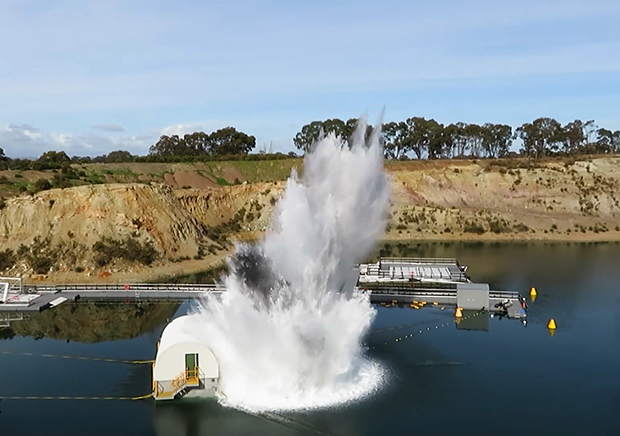
Australia

London, United Kingdom

Diriyah, Riyadh, Saudi Arabia



Pawel Woelke, Managing Principal, Applied Science Practice Co-Leader and UK & Australia Region Co-Leader, Thornton Tomasetti
Juan Londono, Associate Principal, Thornton Tomasetti
Peter Johnson, Director, Thornton Tomasetti
Ivan Boguslavskyi, Associate Principal, Thornton Tomasetti
This article appeared in IEEE Energy Sustainability Magazine, Volume 14, Issue 1, March 2026.
The rapid growth of electric vehicles (EVs) and stationary energy storage systems (ESSs) has intensified the need for a rigorous understanding of lithium-ion battery (LIB) hazards within the built environment. While modern LIBs offer high energy density and long lifecycles, their deployment in enclosed or densely occupied structures introduces distinct safety challenges associated with thermal runaway, flammable off-gas generation, and the potential for fire and explosion. This article reviews the electrochemical and physical mechanisms governing LIB degradation and failure, with a close examination of interfacial layer breakdown, internal short-circuiting, and mechanical failures that can initiate cascading exothermic reactions. Drawing on recent incident data and experimental findings, the influence of vapor dispersion, ignition delay, congestion, and confinement on hazard escalation is examined for real-world scenarios, such as multistory car parks and charging facilities. The article then evaluates practical mitigation measures, including ventilation strategies, structural and spatial design considerations, limitations of conventional fire suppression systems, and early detection methods. The analysis demonstrates that effective risk reduction requires an integrated scenario-driven engineering approach, rather than reliance on isolated mitigation measures. As electrification accelerates, safety frameworks must evolve in parallel with battery deployment to ensure the resilience of the infrastructure that supports these energy systems.