Steve Freihon/Related-Oxford
New York, New York
Global experience.
Regional perspective.
Local impact.
New York, New York
Australia

London, United Kingdom
Diriyah, Riyadh, Saudi Arabia

 Thornton Tomasetti
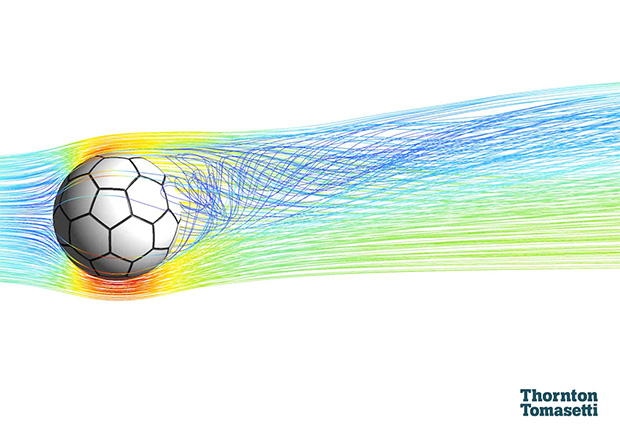
Thornton Tomasetti's Computational Fluid Dynamics (CFD) experts develop and apply codes based on first principles to simulate low- and high-velocity fluid flows, supporting a range of challenges from wind and wave impact to energy-efficient design and fire behavior prediction.
Our CFD Community of Practice (CoP) – a self-organizing, grassroots network of engineers and digital modelers – grew out of an internal event called the CFD Summit and has become a springboard for innovation across disciplines. The CoP has led to new services such as Bioclimatic Design, developed during the COVID-19 pandemic, and Nuada.CFD, a digital wind tunnel app that helps architects and engineers test wind and pressure conditions on designs before construction begins.
We’re proud to highlight two recent, high-impact simulations created by our CFD CoP.
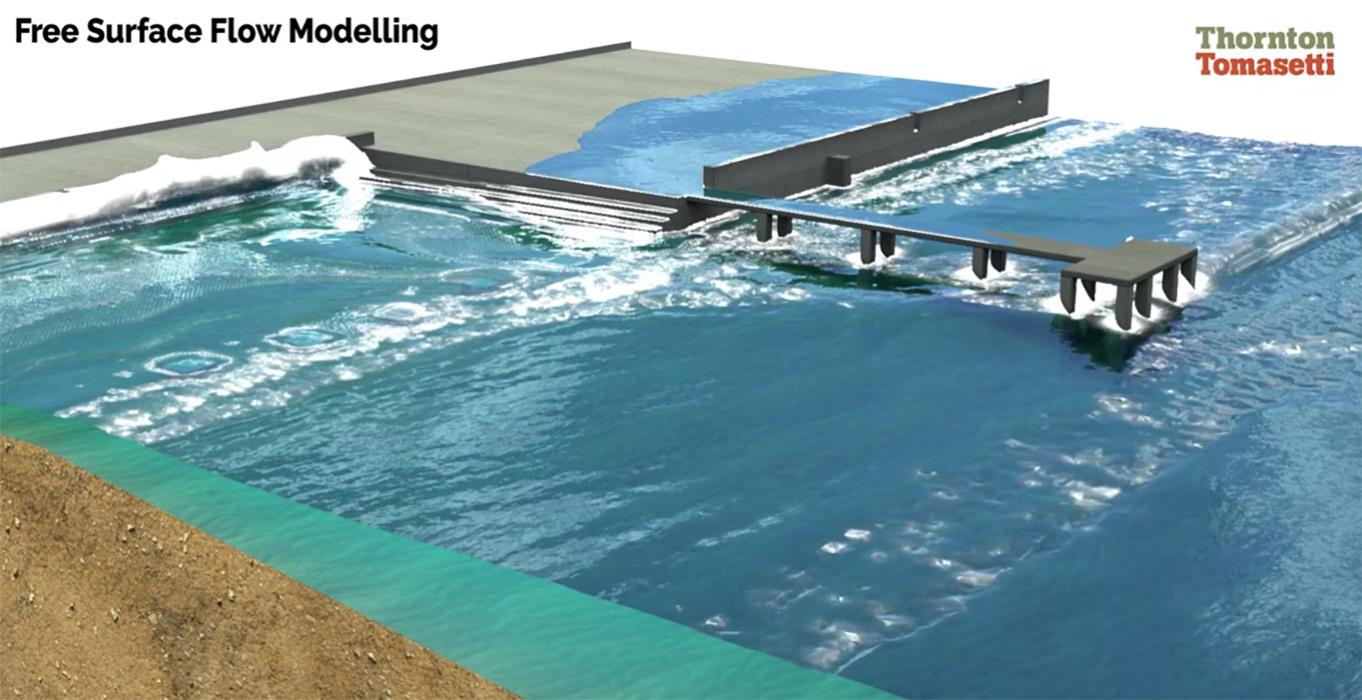
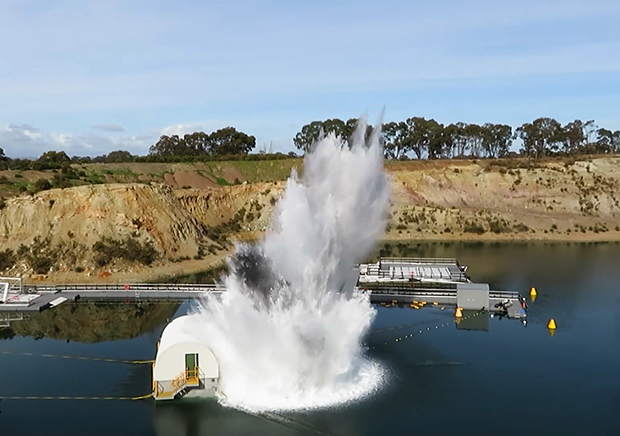
Thornton Tomasetti Senior Engineer Euan Williamson developed a wave simulation model that mimics laboratory wave flume testing environments to study the interaction of water and air on coastal infrastructure. The simulation uses a moving wall boundary, or "flapper," to control wave frequency and amplitude, modeling the impact of sea conditions on built structures.
The model leverages a multiphase approach, solving both water and air flows, and provides actionable data such as pressure forces on sea walls, piers and pedestrian walkways.
“We are able to assess how changes in sea wall and coastal defense design can alter the motion of incoming waves and reduce water overtopping into walkways,” Williamson says.
This work directly supports climate-adaptive design, offering tools for developers, cities and coastal engineers to evaluate how future storm surges, king tides and sea level rise might affect their projects.
Beyond coastal applications, the same CFD approach has been used to analyze liquid containment failures from storage tanks, estimating the potential spread of hazardous liquids and their interaction with stormwater systems—a growing environmental concern during extreme weather events.
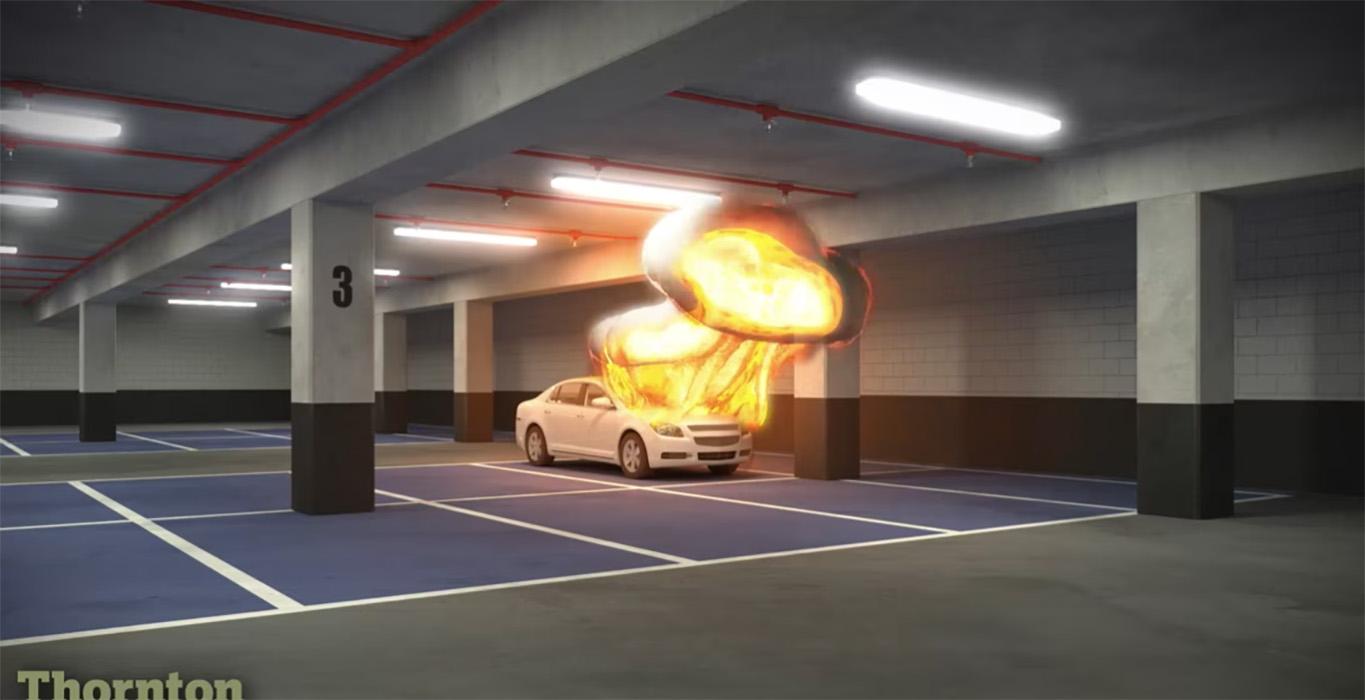
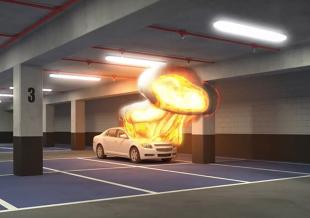
Senior Engineer Sarah Swales and Associate Paul Williamson created a CFD-based simulation of a car battery fire in an enclosed parking structure. As EVs become more common, understanding how thermal runaway, radiation and gas dispersion affect nearby materials and structures is crucial for safe building design.
The model explores key questions:
The simulation can also be extended to other high-risk environments, such as oil and gas rigs, where radiant heat from fires can affect not only nearby structures but also worker safety zones further afield.
These tools allow engineers to simulate risk scenarios and inform design decisions around ventilation design, material selection, compartmentalization and emergency response planning. In the context of urban densification and sustainability, they also support the safe integration of EV infrastructure into existing and new developments.
What sets our CFD practice apart is its collaborative spirit. The Community of Practice fosters technical exchange and creates space for experimentation that leads to real-world solutions and innovations like:
These tools reflect our belief that CFD is not just a niche capability—it’s a strategic enabler of sustainability, resilience and interdisciplinary performance.
As climate events, energy transitions and urbanization trends converge, simulation tools like those developed by our CFD team will become increasingly essential.
From designing flood-resilient waterfronts and optimizing energy performance to preparing for EV-related fire scenarios, computational fluid dynamics empowers teams to make informed, high-performance design decisions earlier in the process.
Interested in how CFD can enhance your next project? Contact our team to learn more about wave simulations, EV fire modeling or digital wind tunnel testing.
Aberdeen, Scotland, United Kingdom
Euan is a Senior Engineer in our Applied Science practice.
Warrington, England, United Kingdom
Sarah is a Senior Engineer in our Applied Science practice.
Aberdeen, Scotland, United Kingdom
Paul is an Associate in our Applied Science practice.