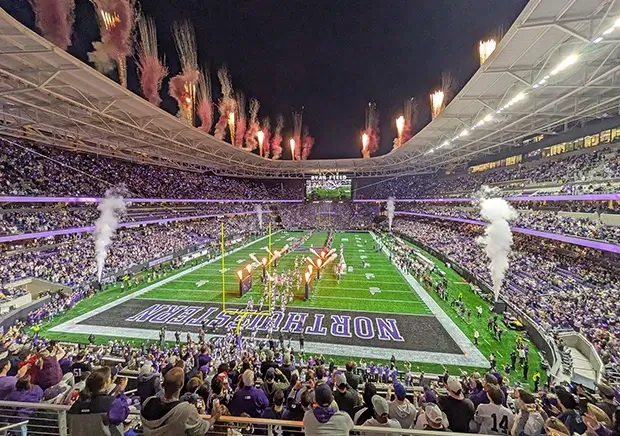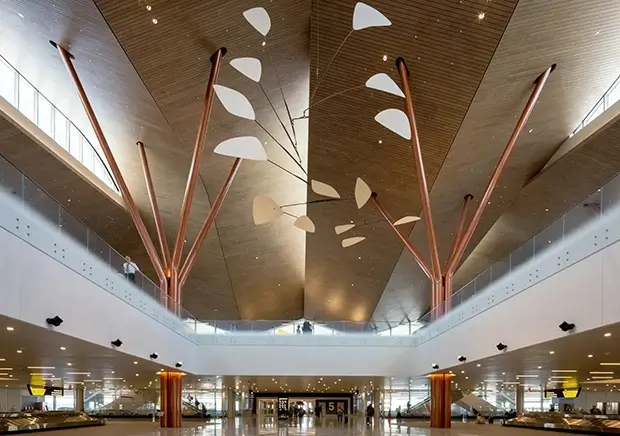

Steve Freihon/Related-Oxford
New York, New York
Global experience.
Regional perspective.
Local impact.
New York, New York
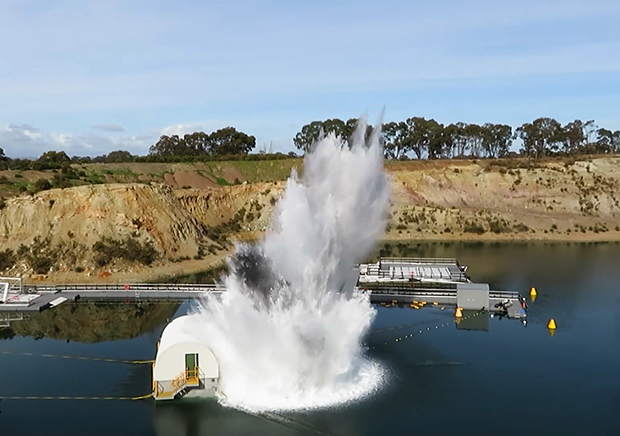
Australia

London, United Kingdom

Diriyah, Riyadh, Saudi Arabia
A perfectly curled free kick is not just the result of power and technique. It is also a visible example of soccer ball aerodynamics, where spin, airflow, and pressure combine to change the path of the ball in flight.
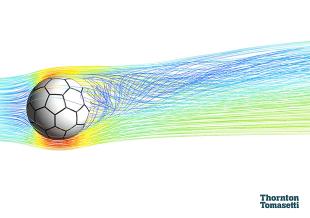
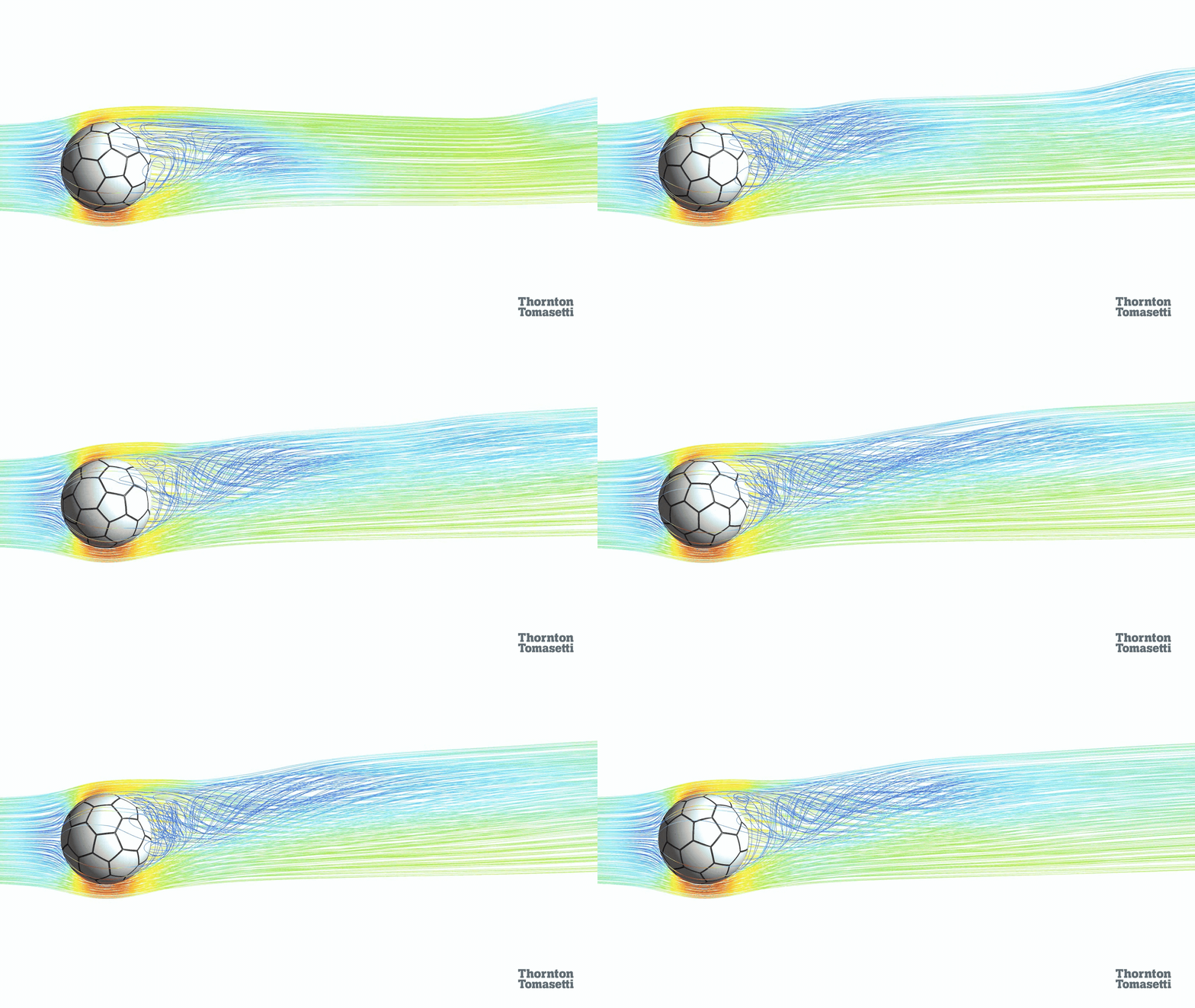
Using computational fluid dynamics, or CFD, we modeled a spinning soccer ball to visualize how airflow moves around the ball and how small changes at impact can influence its trajectory. The simulation shows the fluid dynamics behind one of the most recognizable moments in the game: a ball bending around defenders and dipping toward goal.
When a player such as Cristiano Ronaldo or Lionel Messi strikes a ball through its center of mass, most of the impact energy goes into forward motion. The ball travels with limited rotation, producing a more direct path through the air.
An off-center strike creates a different result. When the boot contacts the ball away from its center of mass, it introduces torque. That torque causes the ball to spin, and the spin changes how air flows around the ball.
This is where the aerodynamics become more complex. The ball is no longer just moving forward; it is rotating through the surrounding air.
The Magnus effect is the aerodynamic force that causes a spinning ball to curve in flight.
As the soccer ball rotates, the surface motion changes the relative airflow on each side of the ball. Air moves faster on one side and slower on the other. This creates a pressure difference across the ball, producing a sideways force that changes its trajectory.
That force is what allows a free kick to bend around a defensive wall, drift away from a goalkeeper, or dip beneath the crossbar.
CFD allows engineers to analyze airflow velocity, pressure distribution, and wake behavior around objects in motion. It is widely used across industries including buildings, transportation, energy, water, and manufacturing.
In this model, we applied CFD to a spinning soccer ball to examine how impact-driven rotation affects flight behavior.
The colored flow lines represent airflow velocity around the ball. Warmer colors show faster-moving air, while cooler colors show slower-moving air and wake regions behind the ball. The simulation highlights how spin creates an uneven flow field, which contributes to the pressure imbalance responsible for curve.
A curved shot can depend on very small differences in how the ball is struck.
A slight change in boot contact point can affect:
These small variations can determine whether a shot travels straight, bends wide, or curves into the top corner.
The CFD model makes that sensitivity visible. It shows how the moment of impact influences the aerodynamic forces acting on the ball throughout flight.
A curled free kick may look like instinct, talent, or even luck. But behind the movement is a clear chain of physics: off-center impact creates torque, torque creates spin, spin changes airflow, and airflow creates the Magnus force that bends the ball.
The next time a free kick curves around the wall and finds the top corner, remember: what looks like magic is fluid dynamics in action.
Want to apply CFD to your next challenge? Connect with our CFD team