
Steve Freihon/Related-Oxford
New York, New York
Global experience.
Regional perspective.
Local impact.
New York, New York
Australia

London, United Kingdom

Diriyah, Riyadh, Saudi Arabia
The University of Texas at Austin is exploring CCUS as an option for reducing campus emissions.


Our involvement in UT Austin’s CCUS feasibility study was what you might call “serendipitous.” It started in 2023, when, during a conversation at a Houston education conference, we asked members of the university’s utilities and planning groups a simple but unexpectedly revealing question: “Have you thought about carbon capture for your campus?” Their reply? “We love the idea, and yes, we are considering it – stay tuned.”
A few months later, the university released a closed request for proposals (RFP) to a select list of engineering firms. Thornton Tomasetti wouldn’t ordinarily have been included in this distribution, due to the project’s MEP focus. But because we had brought the solution to them and had demonstrated an understanding of their campus systems, UT Austin invited us to submit a proposal – and later selected us to lead the technical study.
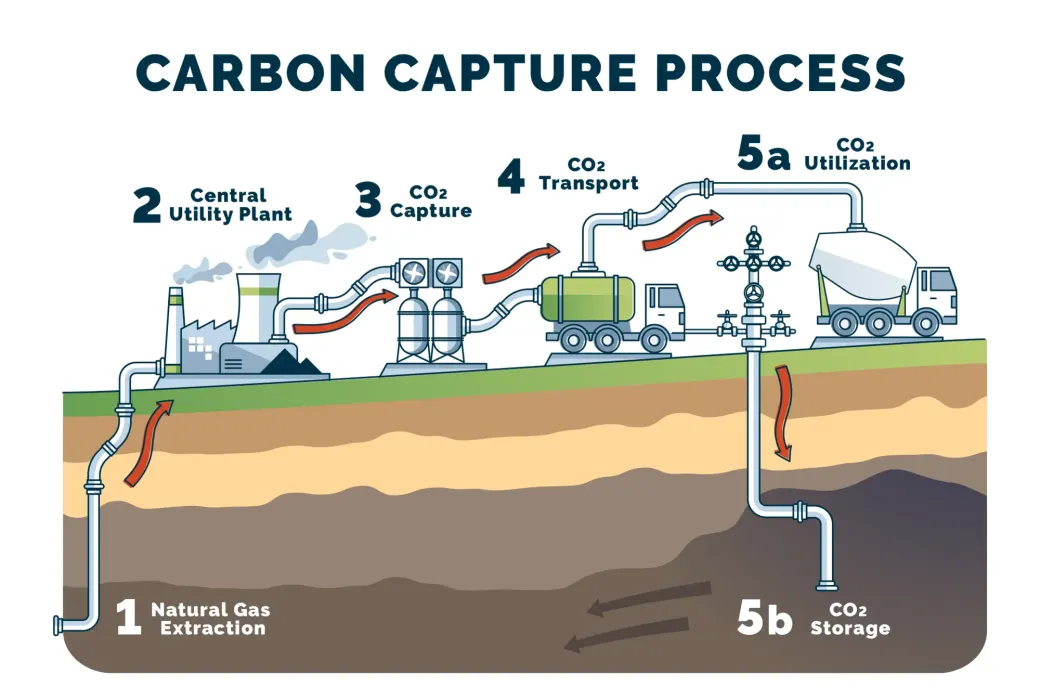
UT Austin operates one of the country’s largest microgrids, producing its own electricity, steam, and chilled water through a combined heat and power system fueled by natural gas. This affords the university a rare opportunity: rather than decarbonizing hundreds of individual buildings, they can target the point source – their central utility plant (CUP) – to dramatically reduce campus emissions.
For economic, political, and logistical reasons, eliminating natural gas isn’t an option at this time, so UT Austin is exploring CCUS as a means of maximizing the benefits of gas while minimizing its environmental impact. CCUS involves treating exhaust gas with a chemical solvent that absorbs CO₂ before it can enter the atmosphere. The solvent then undergoes a regeneration process to release the captured CO₂, which is compressed and either used or sequestered off-site.
Rather than retrofitting the existing heat and power facility, our work initially focused on the feasibility of adapting a new CUP (~50 megawatts) that is being designed to support a major on-campus hospital complex being constructed in partnership with MD Anderson. We advised the engineering team (KFI Engineers) on how to make the new plant “carbon-capture ready,” including upscaling components to provide the utilities needed to run a CCUS system without compromising reliability or resilience.
Let this be one of the arrows in your decarbonization quiver. It may not be the right solution for everybody, but for some fossil-fuel-reliant facilities, it’s an effective option, especially as a bridge technology, for diminishing the impact that combusting natural gas has on our planet.
We performed a complete techno-economic assessment, evaluating technical integration, spatial requirements, and operating demands. And although we didn’t design the CCUS unit itself (that’s vendor-specific), we did review how it would physically and functionally integrate with the utility infrastructure. This analysis took into consideration such factors as proximity to exhaust stacks, available space for new equipment and the plant’s capacity to meet anticipated demand.
We also developed a dynamic Power BI model that allowed UT Austin to explore multiple decarbonization scenarios – including retrofits – factoring in capital costs, operating expenses, and federal incentives like the 45Q tax credit. This was important for reframing the conversation from traditional return on investment to cost per ton of CO₂ captured. It also gave the university a flexible tool for planning other facilities in its network.
Critical components of our study were the practical utilization and storage aspects of CCUS. We researched several options for handling captured CO₂, including sale to manufacturers for use in products like carbonated drinks or as an additive for curing concrete, transporting it off-site in trucks or through pipelines, and piggybacking on the storage systems of local industrial facilities. Long-term storage – typically involving injection into underground saline aquifers via Class VI wells – is an especially viable option, as Texas boasts some of the best geology in the country for this type of permanent CO₂ storage. At the time of this writing, UT Austin is still evaluating the future use of CCUS on campus and continues to involve our team in further studies.
An important takeaway from this project is that deep decarbonization isn’t just theoretical: it’s a real and viable possibility, and it can take place today.
Our handprint measures how our work creates lasting value for our people, our planet, and the communities we serve.
Insight
Practical Decarbonization Beyond Electrification