Steve Freihon/Related-Oxford
New York, New York
Global experience.
Regional perspective.
Local impact.
New York, New York
Australia
London, United Kingdom
Diriyah, Riyadh, Saudi Arabia
When should a historic building be rehabilitated rather than replaced? At San Francisco’s Presidio, Thornton Tomasetti used life-cycle carbon and cost analysis to help answer that question.

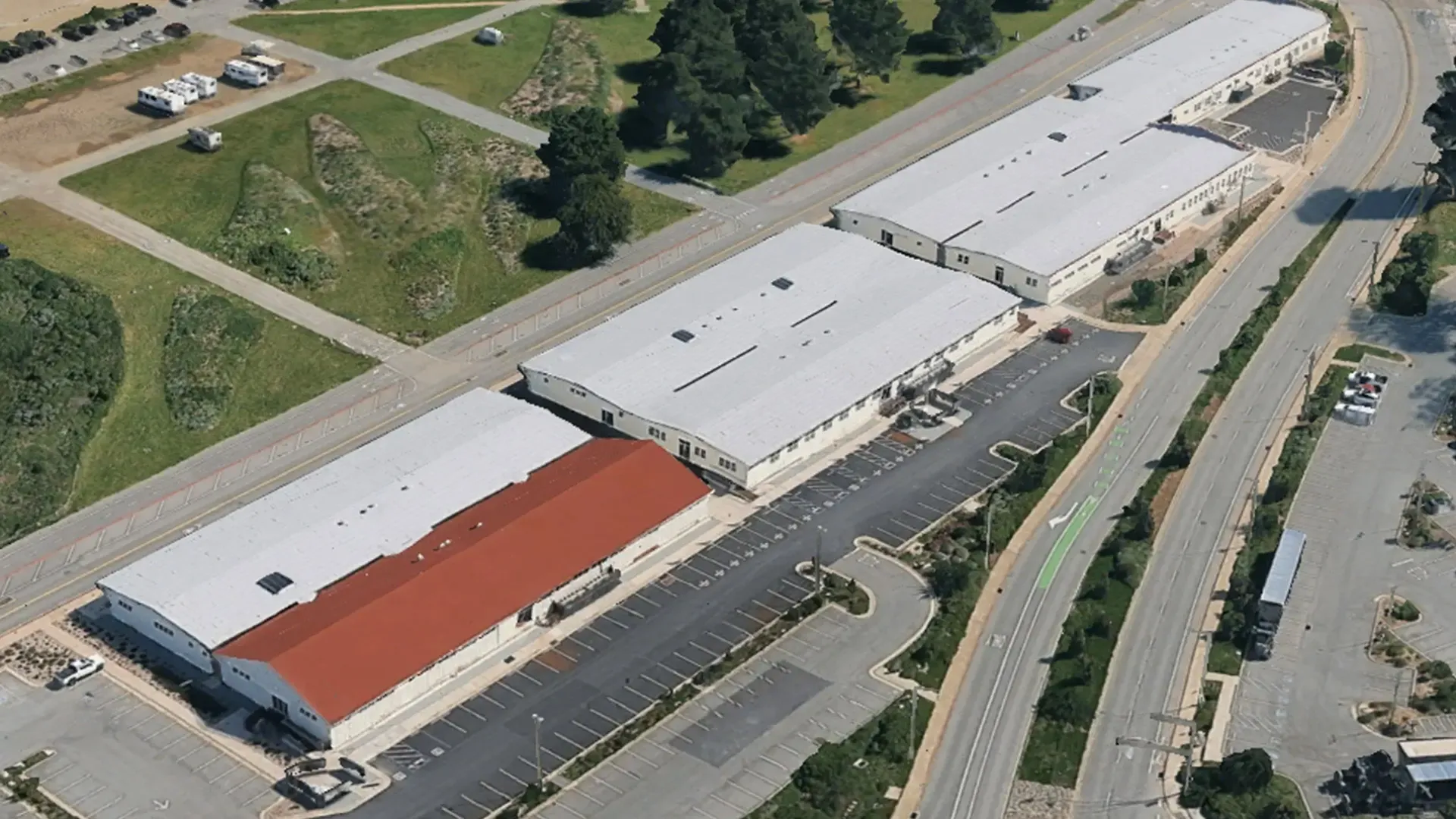
The East Mason Warehouses includes seven circa-1919 wood-framed buildings in San Francisco’s Presidio. In 2023, the Presidio Trust completed their rehabilitation, renewing approximately 89,000 square feet of historic building stock.
Thornton Tomasetti’s 2026 study uses the warehouses to examine a question many owners of historic portfolios face: When is rehabilitation more responsible than replacement? The analysis compares the completed, as-built rehabilitation with a hypothetical new building of similar configuration and use.
The Presidio Trust needed to balance historic preservation, environmental commitments, and long-term fiscal responsibility. The East Mason rehabilitation included seismic retrofitting, new mechanical and electrical systems, restrooms, accessibility upgrades, fire and life-safety improvements, waterproofing, building envelope repairs, and raised outdoor decks.
This real-world scope allowed the team to evaluate the environmental and financial consequences of retaining and upgrading the existing buildings. It also highlighted the technical complexity of renewing historic structures while improving safety, accessibility, building performance, and long-term usability.
We conducted a life-cycle assessment to evaluate environmental impacts across procurement, construction, operation, and decommissioning. The study measured greenhouse gas emissions and embodied carbon, along with other life-cycle impact categories.
The as-built renovation had an embodied-carbon intensity of 76 kg CO₂e/m², compared with 638 kg CO₂e/m² for the hypothetical new building. A reduced-impact new-build scenario provided another benchmark at 498 kg CO₂e/m². These results show why operational energy alone cannot define sustainability. New construction may offer lower modeled energy use, but it also carries substantial upfront carbon impacts.
Our life-cycle cost analysis evaluated total ownership costs over 60 years, including initial costs, operations and maintenance, utilities, replacement costs, and carbon costs. The renovation scenario produced a net present value of approximately $25.9 million, compared with approximately $36.4 million for the hypothetical new building. Total future ownership costs were approximately $53.5 million for renovation and $69.3 million for hypothetical new construction.
By placing carbon and cost in the same decision-making framework, the study helps portfolio owners decide whether to modernize existing buildings or demolish and rebuild.
The East Mason Warehouses study shows how life-cycle evidence can inform preservation, renewal, and capital-planning decisions. Rather than assume rehabilitation or new construction is always the better choice, owners can quantify trade-offs among embodied carbon, operational energy, fiscal responsibility, and continued use.
For the Presidio and other historic building portfolios, this approach supports more informed pathways toward net zero goals – ones that account for both the carbon already invested in existing structures and the long-term costs of keeping them in service.