

Steve Freihon/Related-Oxford
New York, New York
Global experience.
Regional perspective.
Local impact.
New York, New York
Australia

London, United Kingdom

Diriyah, Riyadh, Saudi Arabia

The proposed UK Building Regulations Part Z amendment - an industry-proposed amendment to the Building Regulations 2010 - would make whole-life carbon assessment and embodied carbon reporting mandatory for significant new construction projects for the first time. If enacted, Part Z would move embodied carbon from voluntary best practice into statutory compliance, reshaping how carbon performance is measured and documented across the UK built environment.
UK Building Regulations Part Z is designed to embed whole-life carbon accountability into the UK regulatory framework. Under the proposal:
By legislating what many in the sector already consider best practice, Part Z is positioned not just as carbon reporting, but as a catalyst for transparency and performance improvement across design, procurement and supply chains.
Although Part Z is not yet regulation, it has garnered substantial support from professional bodies and industry stakeholders, including RIBA, UKGBC, CIBSE, and others advocating for regulatory action on whole-life carbon.
Embodied carbon – emissions tied to materials and construction – currently lacks national regulation despite accounting for a significant portion of a building’s lifecycle footprint, prompting calls from Parliament’s Environmental Audit Committee and industry leaders for mandatory whole-life carbon assessment.
Part Z also sits alongside broader UK policy signals aimed at reducing whole-life carbon across both new and existing assets, including the growing emphasis on Retrofit First approaches within London planning policy.
No. Part Z is currently an industry-proposed amendment and proof of concept, not an enacted part of UK Building Regulations.
Part Z would require whole-life carbon assessment and reporting, with embodied carbon limits introduced over time for major construction projects.
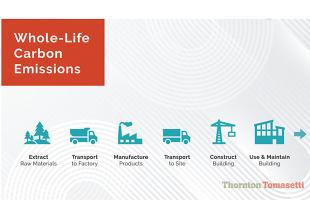
Whole-life carbon assessment measures emissions across a building’s lifecycle, including materials, construction, operation, maintenance, replacement and end-of-life stages.
Part Z matters because it would make carbon performance a compliance issue, increasing the importance of early design decisions, material selection and carbon documentation.
Project teams can prepare by establishing carbon baselines, using RICS-aligned assessment methods, testing low-carbon design options and integrating carbon reporting into design and procurement workflows.
From a practice perspective, Part Z presents both a challenge and an opportunity:
Organisations that have already embedded whole-life carbon workflows will be better positioned to adapt as Part Z moves toward implementation.
At Thornton Tomasetti, we have long recognised the strategic value of integrating whole-life carbon thinking into project design. Our embodied carbon expertise combines advanced lifecycle assessment (LCA) methodologies with multidisciplinary engineering insight to help clients reduce embodied carbon, meet evolving regulatory expectations, and secure competitive advantage.
Recent work – including Stonecutter, one of the lowest reported embodied carbon buildings in the City of London – demonstrates how early material decisions can reduce lifecycle emissions while meeting commercial and design objectives.
We have supported clients in developing embodied carbon baselines, sensitivity analyses, and design strategies that align with both voluntary benchmarks (e.g., RICS Whole Life Carbon Assessment) and expected regulatory frameworks, including the London Plan’s Whole Life-Cycle Carbon Assessments guidance and Circular Economy Statement requirements. This positions us well to support project teams navigating Part Z reporting and compliance – whether through material optimisation, structure-type evaluation, or early-stage carbon planning.
As Part Z progresses from proposal toward potential adoption, embedding robust whole-life carbon assessment workflows will no longer be optional for UK projects – it is fast becoming a regulatory and commercial imperative.
For organisations preparing for this transition, partnering with experienced advisors who understand both the technical requirements and strategic implications of embodied carbon regulation will be critical.
Prepare Your Projects for Future Embodied Carbon Requirements