
R&D and technology play an essential role in our firm. We invest in constant learning, testing and innovation. That uniquely positions us to solve our clients’ most difficult problems.
Innovation EngineOur CORE groups manage our research and development efforts, from incremental efficiency improvements to solving some of the most challenging engineering problems of our time.Learn More
Innovation OutputWe believe collaboration amplifies our innovation potential and creates connections that lead to better, more imaginative solutions for our clients.Learn More
Engineering decarbonization doesn’t stop at the building envelope. Discover how Thornton Tomasetti and Crozier Fine Arts are applying systems engineering and carbon modeling to reduce operational emissions across the global fine art supply chain.
Spurred by the Carbon Leadership Forum’s (CLF) Structural Engineers 2050 Challenge, more companies are recognizing the importance of minimizing embodied carbon (EC).
Thornton Tomasetti’s approach to business management focuses on the three Ps of the triple bottom line, reflecting what we have long recognized: that responsible firms operate and grow in ways that are socially accountable (“people”), environmentally friendly (“planet”) and financially sustainable (“profit”).
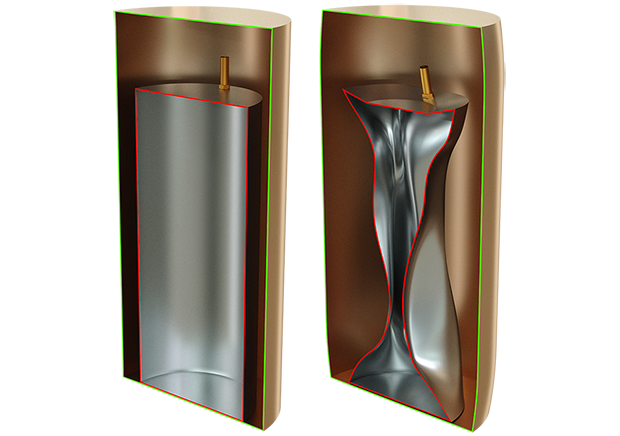
The fast-developing energy transition, with a target of net-zero greenhouse gas emissions, will include a significant expansion in the use of hydrogen. The roles for hydrogen being considered include energy transportation and storage, land transport, maritime propulsion, domestic heating and ‘hard to de-carbonise’ industry. In gaseous form, due to its low density, hydrogen tends to be stored at high pressure, often measured in 100s of bar, though the pressure range will depend on the application.